ISO 9001:2015 certification mark

ISO 9001:2015 Certified by SGS

Industry Technical Publication · 2017

Using 3D Sand Printing Technology in Part Replacement

Nattinee Valun-araya, Ongkarn Chantarasukkasem and John Pearce

Metal Casting Technologies, Volume 63, 1st Quarter, 2017, pp. 20–24

Back to Research & Publications
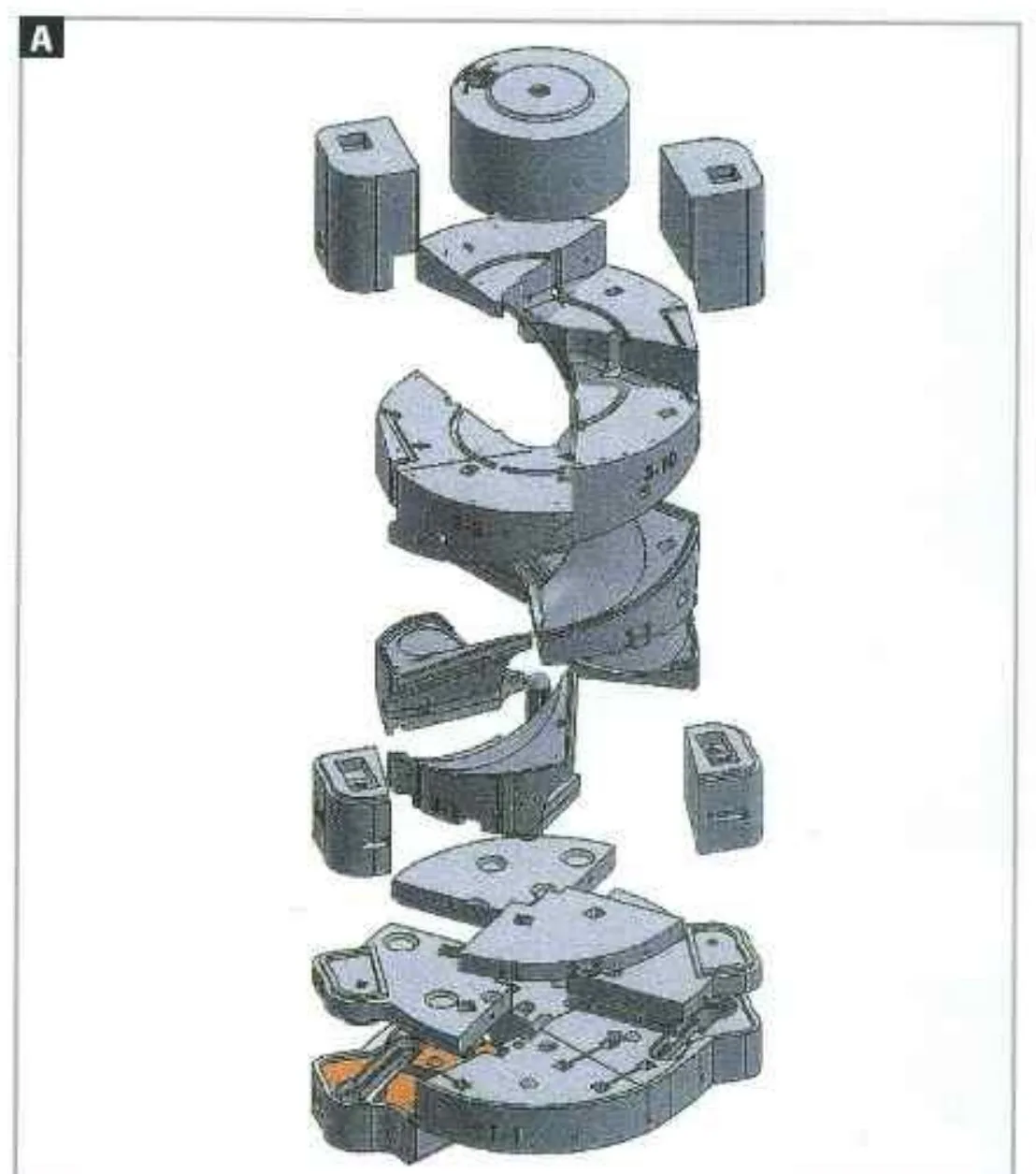
Exploded CAD view of the individual printed sand mould parts used for a ship propeller mould
Exploded view of the parts used for the propeller mould. Figure from Metal Casting Technologies (2017).

Overview

The article looks at how additive manufacturing complements established casting production, and at what that means specifically for part replacement. Where only one or two castings are needed, a pattern is not necessary: sand moulds and cores can be produced directly from CAD data, enabling pattern-less replacement casting, reverse engineering and customisation of cast parts.

Digital mould preparation begins with the geometry itself. Casting layout, gating and feeding were designed using a casting simulation program before any sand was printed. The mould is then produced by binder-jet 3D sand printing, in which resin binder is selectively jetted onto successive layers of pre-mixed sand in a sand bed and the finished parts are cleaned by air jet before assembly.

Two Thai industrial examples carry the argument: a replacement ship propeller for the Royal Thai Navy, and a replacement vertical pump impeller for a pump more than twenty years old. Both were poured at Chaophaya Foundry, a specialist non-ferrous casting producer near Bangkok.

Engineering Challenge

With older equipment, replacement parts are frequently no longer in production or not readily available. A broken or worn out part then keeps plant or equipment out of service while a route back to a casting is found, and in the impeller case described in the article the customer's budget could not support the purchase of a complete new pump unit.

Where drawings or CAD data are not available at all, geometry has to be recovered from the part itself. The article notes that the original part can be 3D scanned to obtain the geometric data needed to sand print a mould for casting a replacement.

Traditional tooling is also slow. Producing a conventional pattern can take up to three to four weeks, with up to five weeks for the eventual supply of the casting. Past experience in Thailand had shown that impellers cast by traditional methods required significant balancing and tended to show excessive dimensional variations, for example in vane angles, reducing efficiency.

Engineering Workflow Demonstrated in the 2017 Publication

Workflow illustrated in this publication. Not every replacement project uses every step.

  1. 01
    Existing ComponentA damaged, worn or obsolete part is identified for replacement.
  2. 02
    Reverse EngineeringWhere drawings or CAD data are unavailable, the original part is 3D scanned to obtain geometric data.
  3. 03
    CAD ReconstructionDigital geometry is prepared as the single source for mould production.
  4. 04
    Mould & Core DesignCasting layout, gating and feeding are designed using casting simulation.
  5. 05
    3D Sand PrintingMould and core parts are binder-jet printed layer by layer in resin-bonded sand.
  6. 06
    Cleaning & AssemblyLoose sand is removed by air jet and the printed parts are assembled into the mould package.
  7. 07
    Metal CastingThe assembled mould is poured, cooled and the casting removed.
  8. 08
    Finished Replacement ComponentThe casting is finished or machined to suit the original installation.
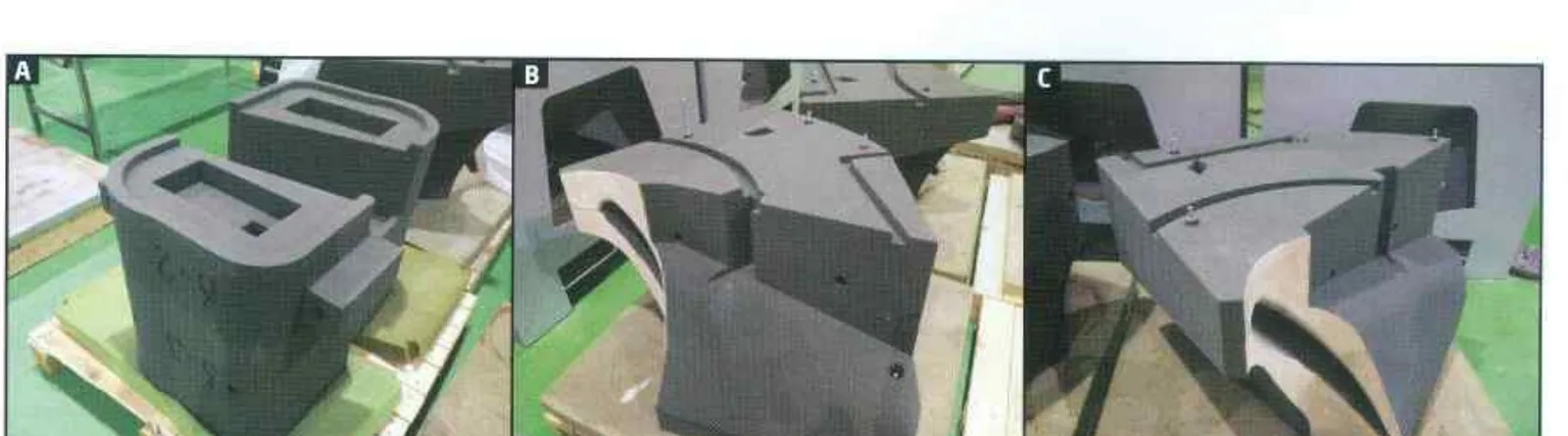
Three printed sand mould parts resting on timber supports before assembly
Examples of printed mould parts prior to assembly.
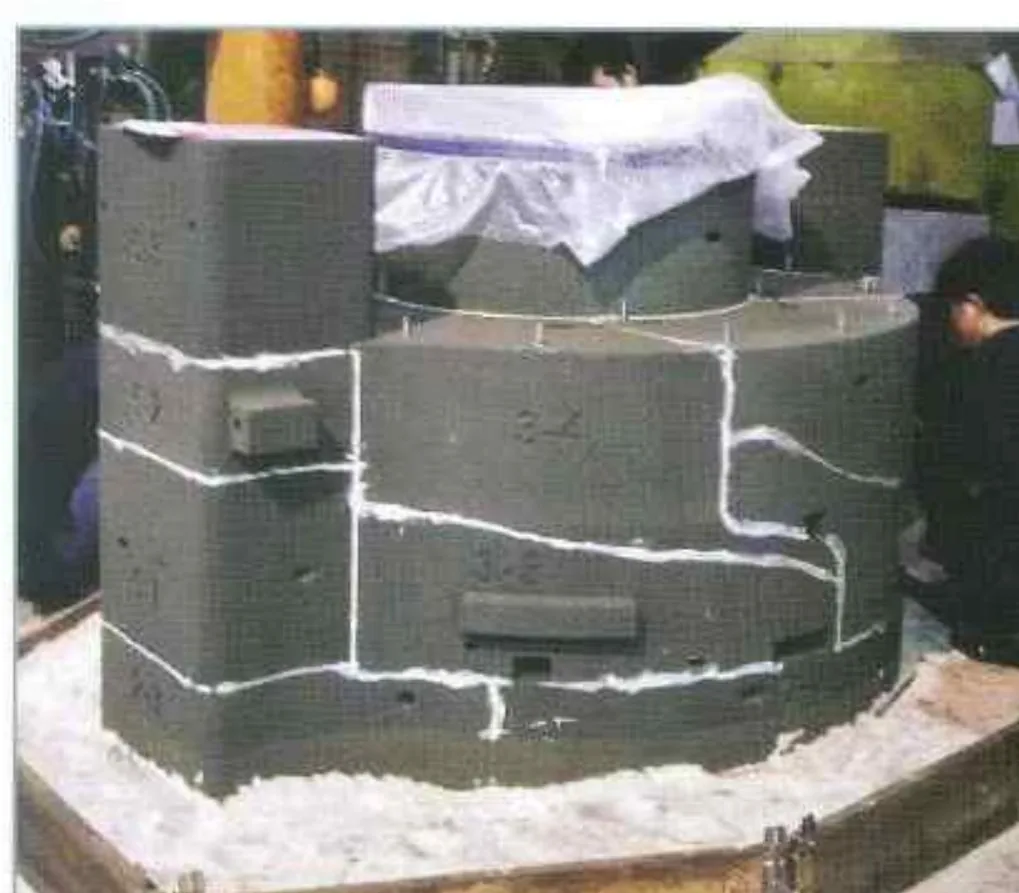
Assembled 3D printed sand mould sealed and banded, ready for pouring
The final assembled mould ready to be poured.

Applications Demonstrated

Replacement ship propeller

Component

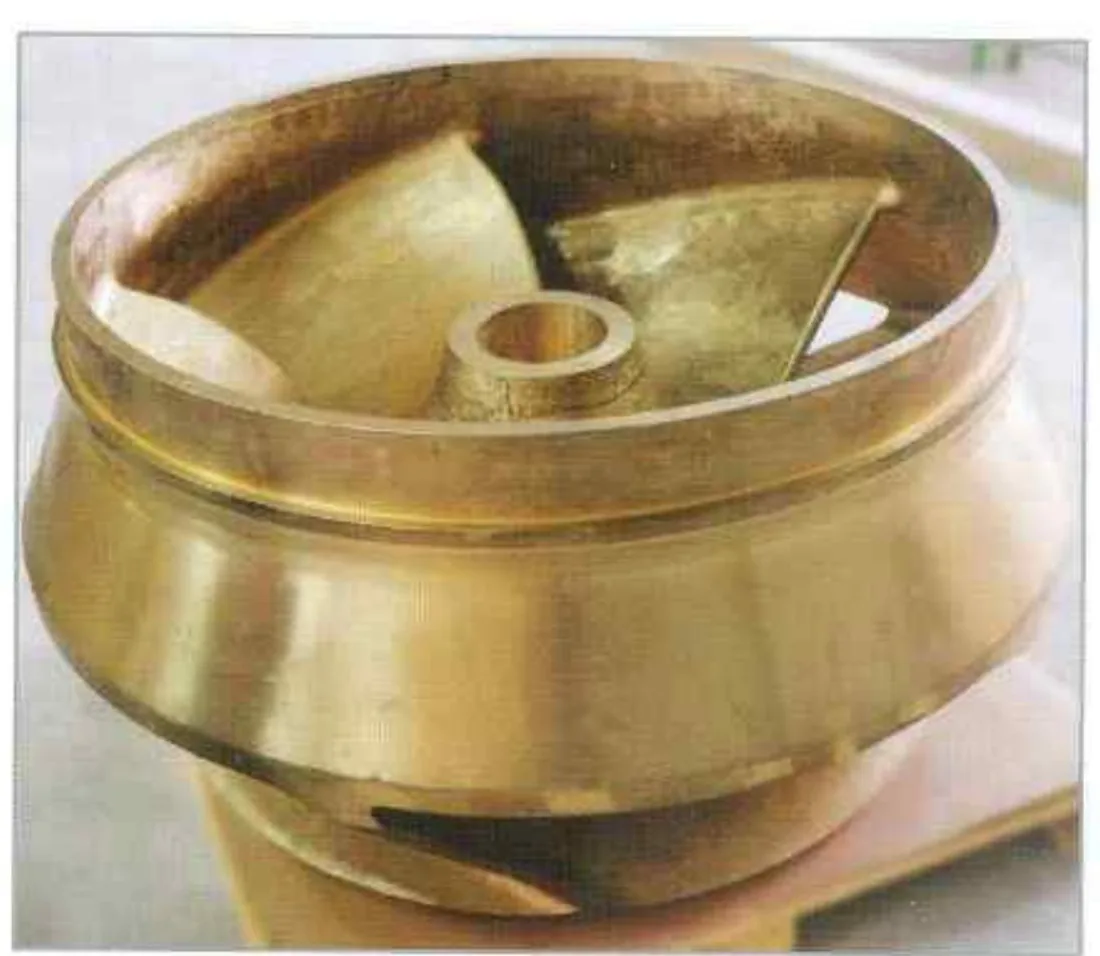
Five-blade ship propeller, finished diameter 1,200 mm, finished weight 650 kg

Application

Royal Thai Navy vessels requiring periodic replacement of propellers damaged beyond repair in service

Engineering approach

The Navy supplied the new propeller profile. Casting layout, gating and feeding were designed with SolidCast. The final 2,400 × 2,400 × 1,500 mm mould was printed as 26 separate silica-sand parts (260 µm average grain size, furan binder) and assembled before pouring.

Reported result

The 26 mould parts printed in 5 days. Test-bar strength was 180 N/cm². The mould was poured at Chaophaya Foundry with 1,600 kg of C95800 aluminium bronze at 1,350 °C, cooled for one day, and the propeller was used as-cast.

The article reports the Navy had been using propellers produced this way for over a year without service performance problems.
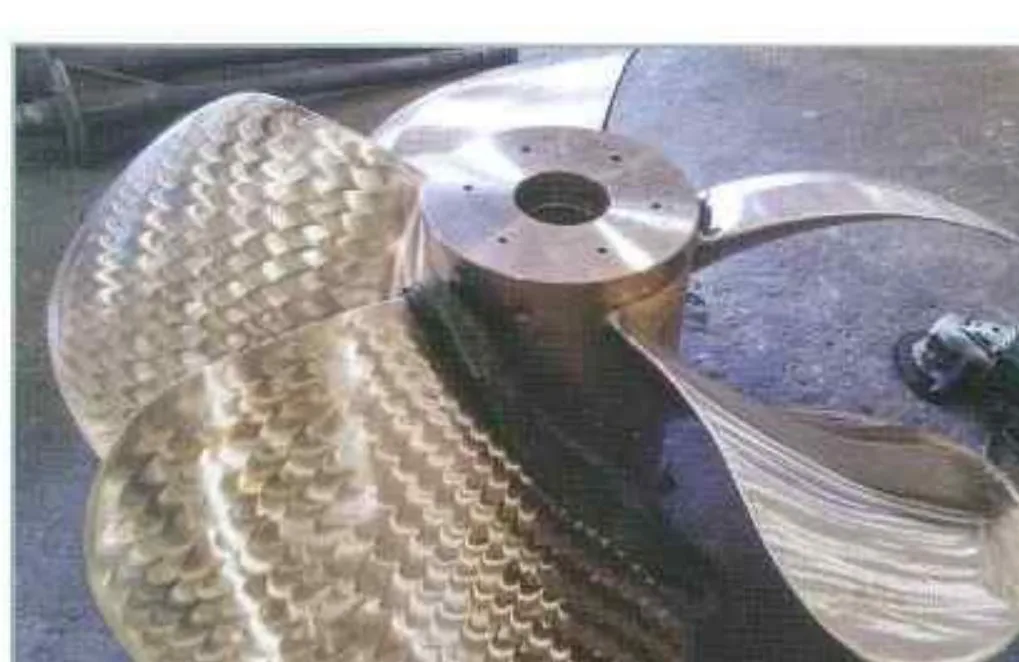
Finished as-cast aluminium bronze ship propeller with machined hub
The finished propeller.

Replacement vertical pump impeller

Component

Pump impeller, finished diameter 1,270 mm, weight 900 kg

Application

A cracked, cavitation-corrosion-damaged impeller in a vertical pump more than 20 years old, with no spare parts available

Engineering approach

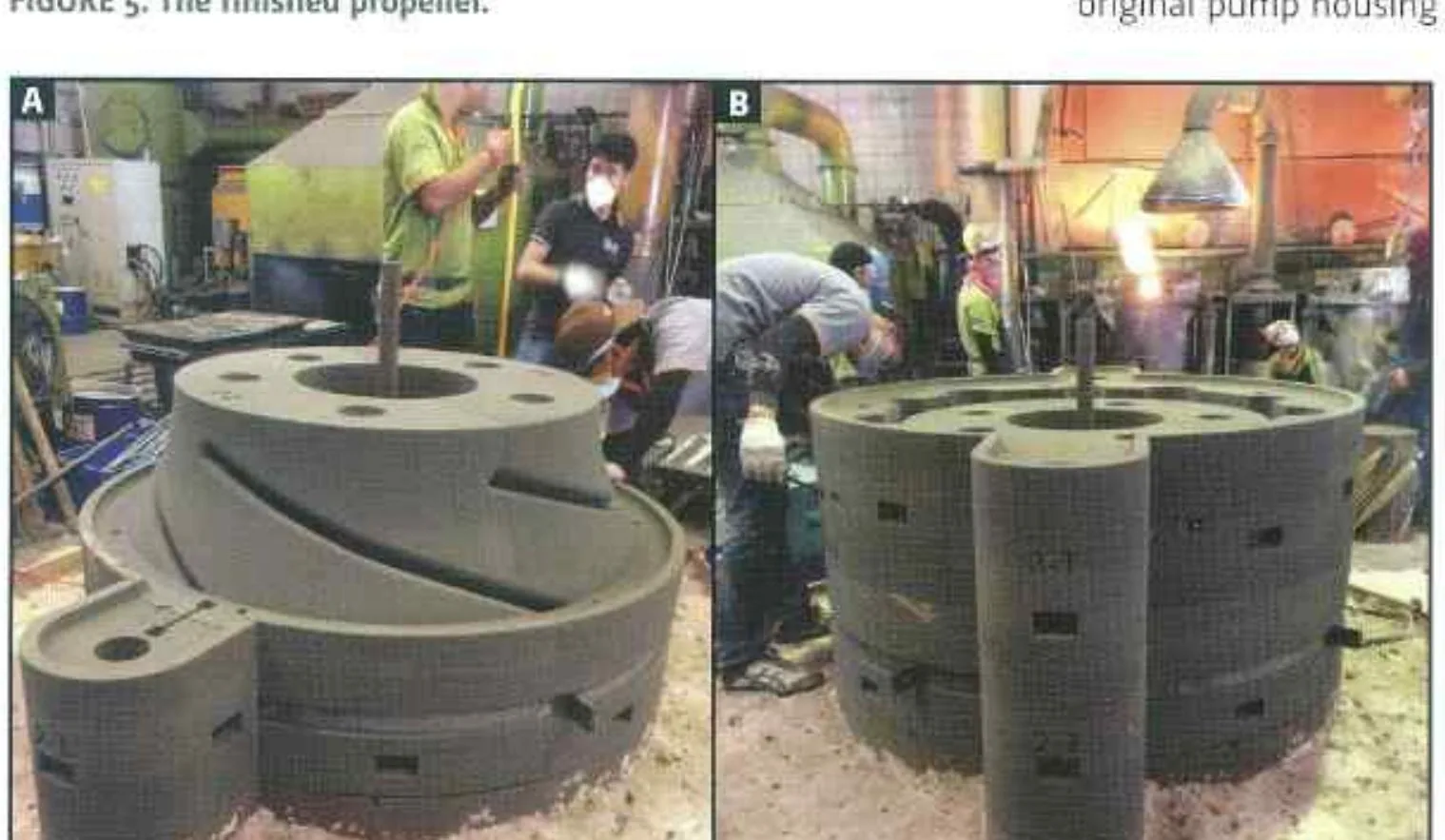
The customer supplied CAD data and specified C95300 aluminium bronze. The replacement had to fit the original pump housing and auxiliaries, and the budget did not allow a complete new pump unit. The mould was designed, printed, assembled and poured as a one-off.

Reported result

The replacement was produced within 6 weeks: one week each for mould design, printing and assembly, and casting. The customer carried out machining.

A conventional pattern route would have cost 80,000 USD; the one-off 3D printed mould cost 50,000 USD, saving 30,000 USD.

Two views of the printed sand mould for the replacement pump impeller during preparation in the foundry
Mould for the replacement impeller during preparation.
Finished aluminium bronze vertical pump impeller after machining
The finished impeller.

Technical Highlights

  • ReplacementBroken or worn parts replaced where spares are no longer produced or readily available.
  • Digital EngineeringMoulds and cores produced directly from CAD data, without patterns or core boxes.
  • ProcessBinder jetting of furan resin onto pre-mixed silica sand, built in incremental layers.
  • AssemblyOne propeller mould was printed as 26 separate parts and assembled without cure time.
  • Marine ApplicationReplacement ship propellers cast in C95800 aluminium bronze for the Royal Thai Navy.
  • Pump ApplicationReplacement vertical-pump impeller cast in C95300 aluminium bronze for a 20-year-old pump.

Key Engineering Takeaways

  • Patternless replacement production removes the pattern and core box from the critical path.
  • Reverse engineering by 3D scanning supplies geometry when drawings or CAD data no longer exist.
  • Binder-jet printed sand moulds are built directly from digital data and need no cure time.
  • Complex mould geometry can be split into many printed parts and assembled into one package.
  • Marine and pump replacement components are demonstrated as practical industrial applications.
  • Only digital files need to be stored, reducing pattern storage and spare part stock.

Publication Reference

Valun-araya, N., Chantarasukkasem, O. and Pearce, J. "Using 3D Sand Printing Technology in Part Replacement." Metal Casting Technologies, Volume 63, 1st Quarter, 2017, pp. 20–24.

Industry Technical Publication · 2017

This publication is presented as a technical summary. Publication in Metal Casting Technologies does not imply endorsement or certification of Speed 3D Mold.

Discuss a Replacement Component

If a part is obsolete, damaged, or has no remaining drawings, our engineering team can review it and advise on a patternless replacement route.

Technology Representation

ExOne logo

ExOne Sales Representative in Thailand

Speed 3D Mold Co., Ltd. is listed by ExOne as a sales representative in Thailand, supporting local coordination for industrial sand 3D-printing solutions.

Verify our listing on ExOne’s official global support network.

View Official ExOne Listing

MEMBERS & SOCIETIES

Thai Foundry Association
FTI