
ISO 9001:2015 certification mark

ISO 9001:2015 Certified by SGS

Back to Case Studies

Pump Replacement Case Study · Large Aluminium Bronze Impeller

1,270 mm Vertical Pump Impeller Reproduced from a Damaged Existing Component

A replacement impeller was required for a vertical pump that had remained in service for more than 20 years. With no original pattern available, the damaged impeller became the engineering reference for reconstructing and manufacturing one C95500 aluminium bronze replacement.

View Pump Replacement Engineering
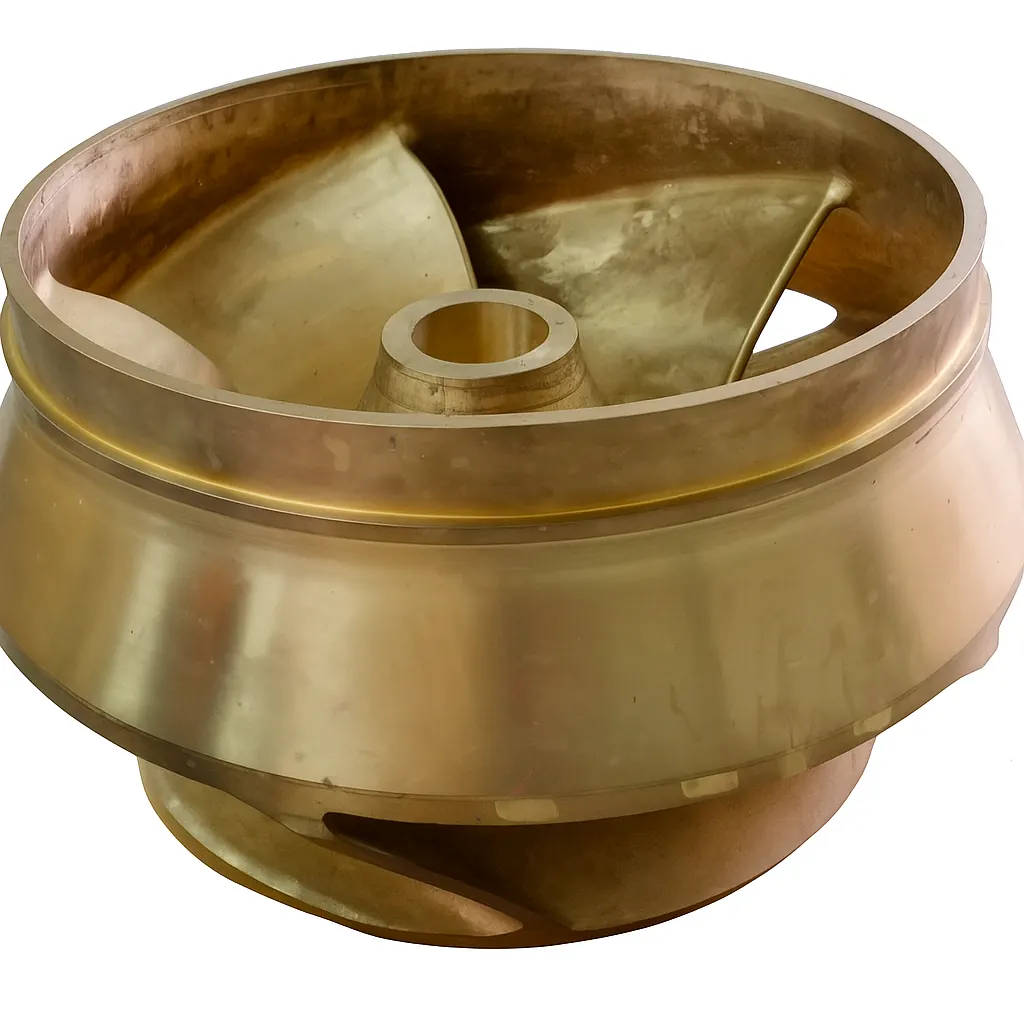
Finished 1,270 mm vertical pump replacement impeller in C95500 aluminium bronze
Finished replacement impeller documented for the 20-year-old vertical pump project.

Project at a Glance

Component
Vertical Pump Impeller
Finished Diameter
1,270 mm
Cast Weight
900 kg
Material
ASTM B148 C95500 Aluminium Bronze
Quantity
One replacement
Project Window
4 weeks through completed machining

The Replacement Challenge

One Damaged Reference, No Original Tooling

The pump had been operating for more than 20 years. Its removed impeller showed cracking and cavitation/corrosion damage, and the original pattern and tooling were not available.

Only one replacement impeller was required. The new component therefore had to be reconstructed from the damaged physical reference while preserving the relationships needed for the existing pump assembly.

The project required casting and machining to be completed within a four-week project window.

Manufacturing Decision

Why a Patternless Route Was Selected

With no original pattern available and only one replacement impeller required, the project followed a patternless manufacturing route. The damaged component was used as the engineering reference, reconstructed in CAD, and converted into a 3D-printed sand mould for casting.

3D sand printing produced the sand mould—not the metal impeller itself. The replacement impeller was cast in C95500 aluminium bronze using that mould.

What Was Reconstructed and What Had to Be Preserved

Reverse engineering was not a simple scan-and-copy exercise. Damaged geometry had to be interpreted during CAD reconstruction.

Reconstructed or reviewed

  • Worn, cracked or damaged geometry
  • Missing or degraded surfaces
  • Manufacturable CAD geometry
  • Casting and machining allowances

Preserved as engineering references

  • Interfaces with the existing pump assembly
  • Hub and connection geometry
  • Critical mounting relationships
  • Usable geometry remaining on the original component

Engineering-to-Manufacturing Workflow

From the Removed Component to a Machined Replacement

Total project window: four weeks through completed machining.

  1. 01

    Existing Component Assessment

    Review the removed impeller and identify usable reference geometry, wear, cracking and cavitation/corrosion damage.

  2. 02

    Dimensional Capture

    Record principal dimensions and the interfaces needed for reconstruction.

  3. 03

    3D Scanning

    Capture the complex physical geometry of the damaged reference component.

  4. 04

    CAD Reconstruction

    Rebuild the component as manufacturable engineering geometry rather than copying the damaged condition directly.

  5. 05

    Casting Engineering

    Prepare the reconstructed geometry for mould production and casting.

  6. 06

    3D-Printed Sand Mould Production

    Produce the one-off sand mould directly from the prepared digital data without an original pattern.

  7. 07

    C95500 Aluminium Bronze Casting

    Cast the replacement impeller in ASTM B148 C95500 aluminium bronze.

  8. 08

    Machining

    Complete the required machining of the replacement component.

  9. 09

    Inspection and Balancing

    Perform the checks and balancing included in the original project.

Project Evidence Gallery

Documented Mould and Finished Component

The available published project figures show the one-off sand mould during preparation and the finished impeller after machining.

Printed sand mould package for the replacement impeller during preparation before pouring.
The finished C95500 aluminium bronze replacement impeller after machining.

Verified Project Outcome

  • One 1,270 mm replacement vertical-pump impeller was produced.
  • The cast component weighed 900 kg.
  • ASTM B148 C95500 aluminium bronze was used.
  • A one-off 3D-printed sand mould was used without an original pattern.
  • Casting and machining were completed within the four-week project window.
  • Inspection and balancing were included in the project workflow.

Detailed historical inspection records from this earlier project are not presented on this page.

Published Technical Evidence

Documented in Published Technical Work

This vertical-pump impeller project is included in Speed 3D Mold’s published documentation on using 3D sand printing for replacement-part production.

Using 3D Sand Printing Technology in Part Replacement · Metal Casting Technologies, 2017

Read the Published Documentation

Engineering Boundary

Every replacement project is reviewed individually. Geometry, alloy, inspection requirements, machining scope and lead time depend on the condition of the reference component, the available engineering information and the operating requirements. The four-week project window is a documented result from this case, not a standard lead-time promise for every future project.

Project-Specific FAQ

Can a pump impeller be reproduced without the original drawing?

It can be possible when enough usable geometry and interface information remain on the component. The physical part can become the starting point for reverse engineering and CAD reconstruction.


Can a damaged impeller be used for reverse engineering?

Yes, subject to engineering review. Damage and wear mean the measured condition cannot simply be copied; usable reference geometry must be separated from areas requiring reconstruction.

How are worn or missing surfaces handled during CAD reconstruction?

They are interpreted using the remaining geometry, measurable relationships, available engineering information and the interfaces that must be retained. Feasibility depends on the condition and completeness of the reference.

Why was a 3D-printed sand mould used for this replacement?

Only one impeller was required and no original pattern was available. The approved digital geometry could therefore be used to produce a one-off sand mould without recreating conventional pattern tooling. The metal impeller itself was cast in the printed sand mould.

Does every replacement impeller take four weeks?

No. Four weeks through completed machining is the documented window for this case. Future timing depends on geometry, alloy, reference condition, quantity, machining and inspection scope.

Need to Reproduce a Large or Obsolete Pump Component?

Send available photographs, principal dimensions, drawings or CAD data, material information, required quantity and the requested machining or inspection scope for an initial engineering review.

View More Case Studies

Technology Representation

ExOne logo

ExOne Sales Representative in Thailand

Speed 3D Mold Co., Ltd. is listed by ExOne as a sales representative in Thailand, supporting local coordination for industrial sand 3D-printing solutions.

Verify our listing on ExOne’s official global support network.

View Official ExOne Listing

MEMBERS & SOCIETIES

Thai Foundry Association
FTI